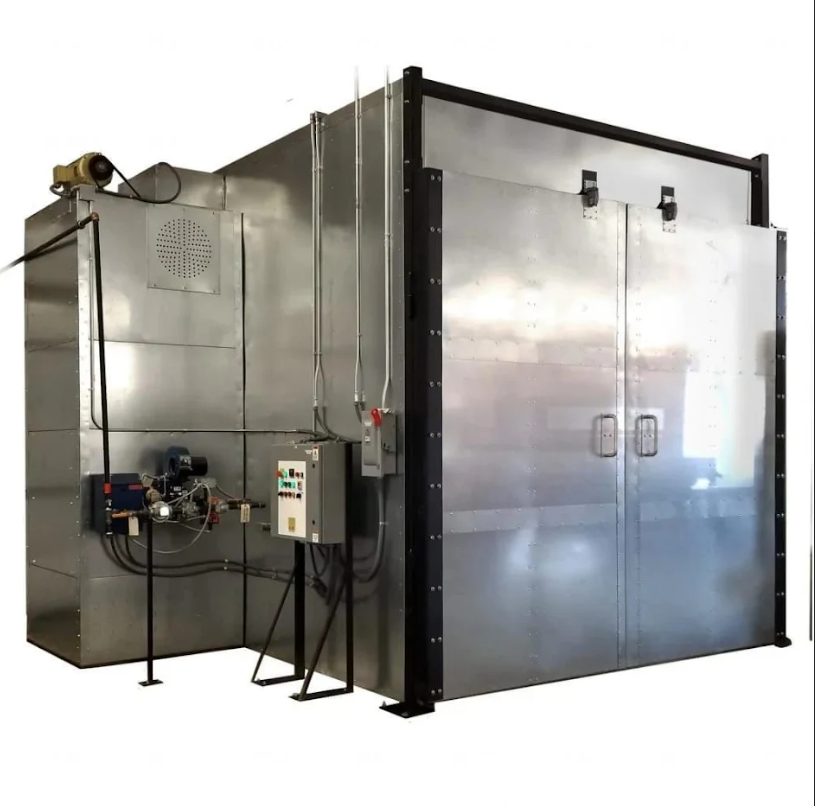
Speed inside a finishing line rarely comes from a single upgrade; it comes from how heat, air, and chemistry work together. An industrial powder coating oven is designed around that relationship, allowing coatings to cure faster without sacrificing adhesion or durability. Understanding what sets these ovens apart explains why modern powder coating systems outperform traditional thermal equipment.
Direct Radiant Heat Transfer
Radiant heat plays a major role in how quickly coated parts reach curing temperature. Unlike conventional ovens that rely heavily on ambient air warming, industrial powder coating ovens use radiant energy to transfer heat directly to the metal surface. This method minimizes lag time and reduces the energy lost to surrounding air.
Because heat is absorbed immediately by the substrate, powder particles begin flowing and cross-linking sooner. This direct interaction shortens dwell time inside the oven. Many powder coating ovens designed for production environments rely on this principle to maintain fast line speeds while keeping finishes consistent.
Inside-Out Curing
Traditional ovens often heat the surrounding air first, then slowly warm the part surface. Industrial powder coating ovens approach curing differently by driving heat into the metal itself. Once the substrate heats, it transfers energy outward to the powder layer.
That internal heat flow promotes even curing across complex shapes and varying thicknesses. Corners, edges, and dense parts reach proper cure without extended exposure. This inside-out approach is a key reason an industrial powder coating oven can outperform batch-style equipment found in smaller powder coating equipment packages.
High-Velocity Forced Convection
Air movement inside the oven chamber matters as much as temperature. High-velocity forced convection systems circulate heated air aggressively around parts, stripping away cooler boundary layers that slow heat transfer. This constant movement ensures uniform exposure across the entire load. Stronger airflow also helps recover heat faster after doors open or conveyors advance. Compared to standard powder coating ovens, these systems stabilize temperature quicker, allowing continuous operation. That efficiency is especially valuable when evaluating powder coating equipment for sale intended for high-volume use.
Rapid Instant-On Heating
Older ovens often require long warm-up periods before reaching usable temperatures. Industrial powder coating ovens are built with instant-on heating elements that respond quickly to demand. This allows the system to reach target cure temperatures in a fraction of the time.
Fast heat response reduces idle time and supports flexible production schedules. Lines can pause and restart without hours of reheating. For manufacturers running multiple shifts, this capability significantly improves throughput across powder coating systems.
Zoned Thermal Control
Uniform heat does not always mean identical heat everywhere. Zoned thermal control divides the oven into independently managed sections, each tailored to the curing profile of the coating and part geometry. Entrance zones ramp heat gradually, while core zones maintain precise curing temperatures. This segmentation prevents overheating while still accelerating cure time. Parts move through optimized heat stages rather than sitting in a single temperature environment. Zoned control is a defining feature in many industrial powder coating oven designs intended for fast, repeatable results.
Variable Frequency Drive (VFD) Optimization
Fans and blowers play a major role in heat delivery. Variable frequency drives allow airflow to be adjusted dynamically based on load, part size, and coating requirements. Instead of running at a constant speed, air movement responds in real time.
This adaptability improves heat transfer efficiency without wasting energy. Faster airflow where needed shortens cure time, while reduced speed in other zones maintains stability. Powder coating equipment built with VFD optimization consistently outperforms fixed-speed systems in both speed and energy control.
Enhanced Thermal Insulation
Heat retention is just as important as heat generation. Industrial powder coating ovens use advanced insulation materials that limit thermal loss through walls and doors. Less heat escaping means more energy stays focused on curing the coated parts.
Improved insulation stabilizes internal temperatures, reducing recovery time between cycles. This consistency allows lines to run faster without temperature swings. High-performance insulation is often overlooked when comparing powder coating equipment for sale, yet it directly impacts cure speed.
Precision Airflow Balancing
Air must move evenly to avoid hot and cold zones. Precision airflow balancing ensures each section of the oven receives the correct volume and velocity of heated air. Dampers, baffles, and duct design work together to maintain uniform conditions.
Balanced airflow prevents undercured areas that would otherwise require longer dwell times. By eliminating temperature inconsistencies, industrial powder coating ovens maintain faster line speeds without risking finish quality. This design advantage separates production-grade powder coating systems from general-purpose ovens.
Advanced Low-Bake Catalyst Integration
Powder chemistry also contributes to faster curing. Modern low-bake formulations include catalysts that activate at lower temperatures. Industrial powder coating ovens are engineered to work seamlessly with these coatings, delivering precise thermal profiles that trigger rapid cross-linking.
This integration allows full cure at reduced temperatures and shorter exposure times. Less heat means faster processing and lower energy use. When paired with the right powder coating equipment package, low-bake technology significantly shortens cycle times while maintaining durability.
Reliant Finishing Systems supports manufacturers by designing and supplying industrial powder coating ovens built for speed, consistency, and efficiency. Their solutions focus on aligning oven performance with modern coating technologies and production demands. With the right system design, faster curing becomes a predictable part of the finishing process rather than a limitation.